Tujeon Korean playing cards
Tujeon 투전 (Chinese 鬪錢/鬪牋/投牋) “fighting tablets”
Surviving specimens vary in dimensions, but are often made from silk or oiled paper and are typically 1-2 cm x 10 – 20cm. Packs are suits 1-9 with one “general”, and may have 25, 40, 50, 60 or 80 cards. Depending on influence from local customs and ordinances, as they are in Europe, Japan, etc. Language has elements of card games, as happens in other cultures as well.
They are generally believed to be based on Madiao/Majopae cards from China. One story dates them to the reign of King Sukjong (1674 -1720), another to their portrayal in a performance of a Chinese play (1628-1644). Ethnographer Stewart Culin suggested in his 1895 book Korean Games, with notes on the corresponding games of China and Japan that Tujeon may be based on ancient divination arrows, but modern scholars do not strongly support this.
Tujeon play was widespread during the Joseon Dynasty, and overtook Baduk (Go) and Janggi (Chess) in popularity.
Hwatu (Hanafuda) cards introduced in the 19th century proved to be popular enough to cause the decline and ultimate demise of Tujeon games.
Tujeon card games include Baccarat, Blackjack, and Ombre style games. Influences can be a mix of influences from China and Japan.
yeot bang mangyi 엿방망이
dollyeodaegi 돌려대기
dongdongi 동동이
dong dang 동당
gagu 가구
udeungppopgi 우등뽑기
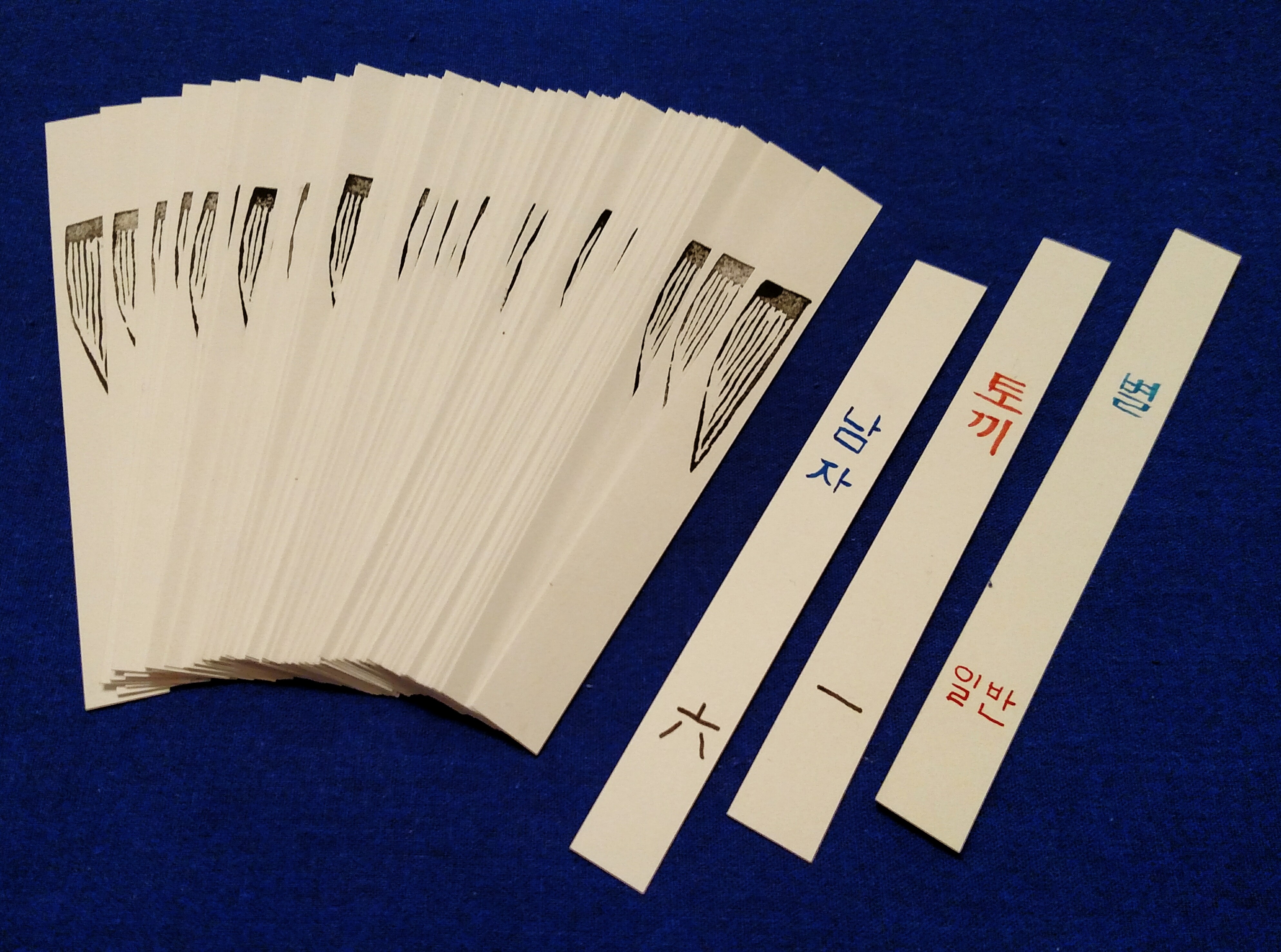
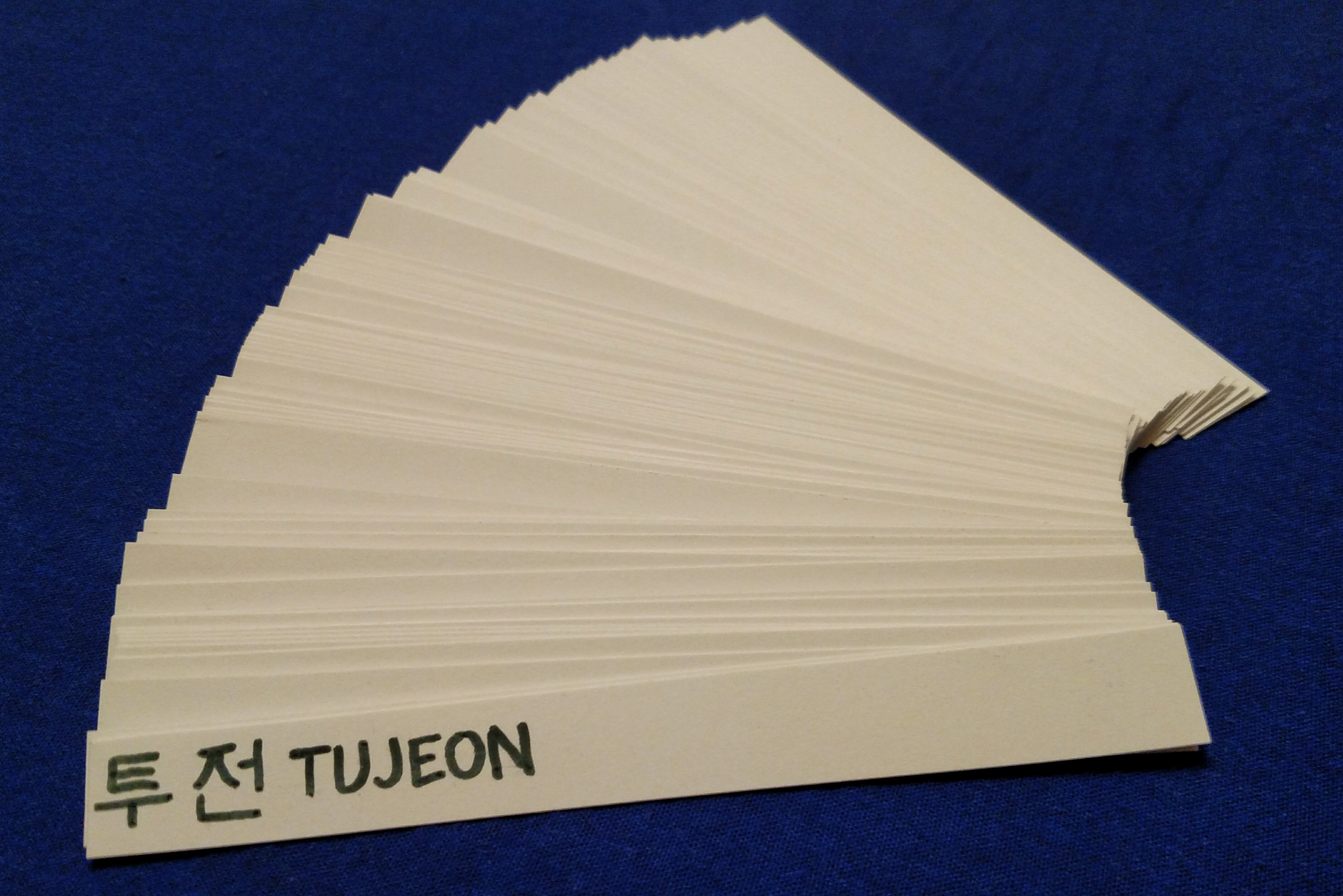
my Tujeon Pack
For dimensions I referenced the few packs encountered; they will be 15 x 150 mm.
Available suits include
-humans, fish, cattle, pheasants, roebucks, stars, hares, horses, crows…
Existing specimens also feature strong calligraphic elements, and even native readers suggest players memorize the cards before play.
At some point compulsion will likely drag me into understanding historic Korean calligraphy better, as the reputed ease of the (modern) writing system makes it inviting. Meanwhile, I wish to emphasize the different suits without too much distortion from historic examples.
For this prototype, I’m going with Hangul for the suit signs and Hanja (Chinese) for numerals, except the “general” cards, also in Hangul.
Prototype Production
* Paper cutter set up to desired dimensions, proceeded to cut up several sheets of smooth bristol paper for a pile of card blanks.
* Layout template for suit signs, etc. on drafting surface
* Cut “feather” stamp from printing medium, ink and test
* Stamp cards over template for consistency, Let dry overnight
* Flip cards over, ink suit signs
* Ink number signs, let dry overnight. Since they rub in play, I want to be sure.
* Scrutinize and edit with surplus blanks
* Gently seal with clear coat.
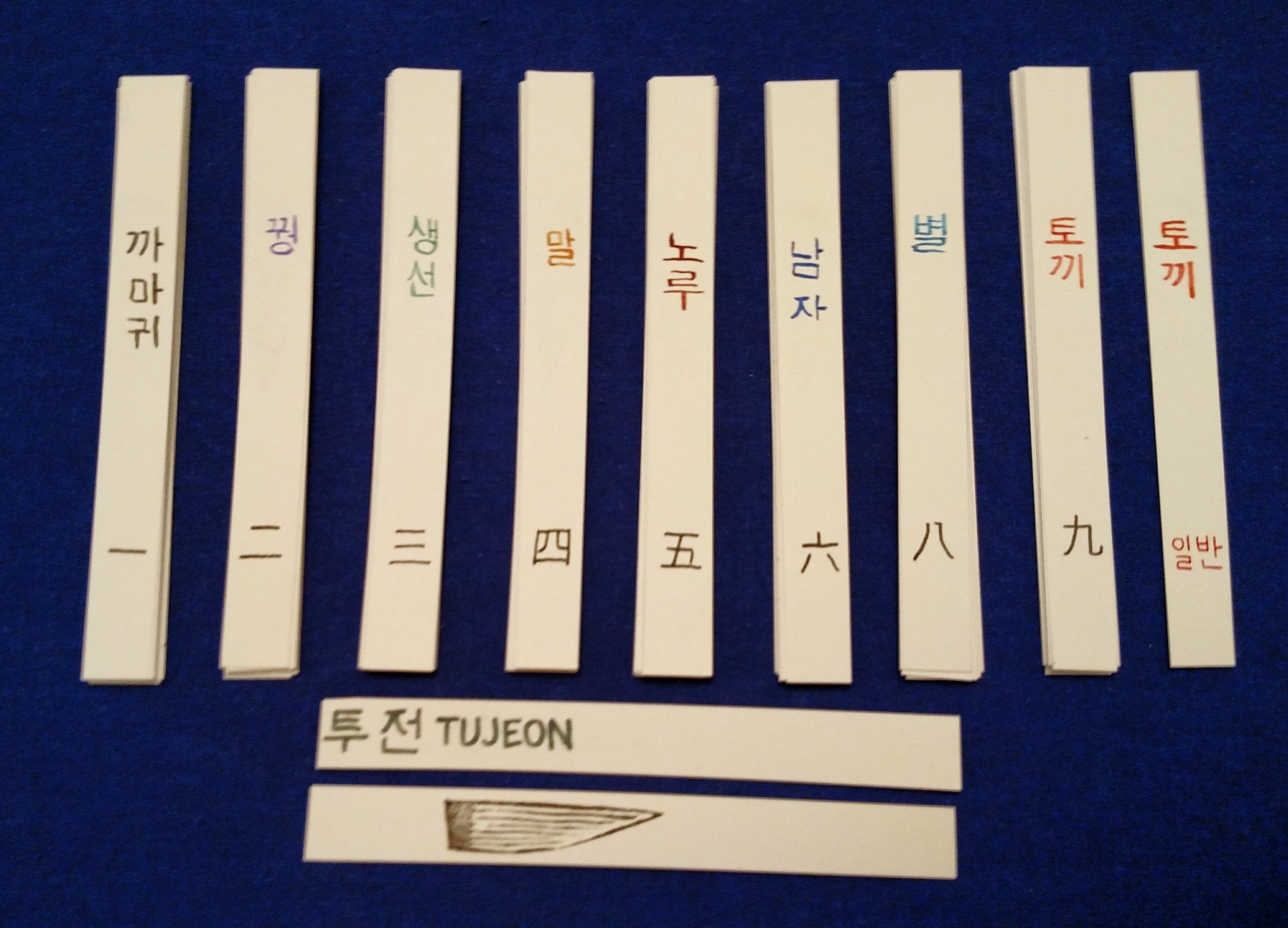
Tujeon suits and numbers
this link features images of art with tujeon cards in play
http://bebop21.tistory.com/272
https://literaryeyefordrama.wordpress.com/2016/04/03/daebak-extracurricular-tujeon/
https://en.wikipedia.org/wiki/Tujeon
https://commons.wikimedia.org/wiki/Htou-tjyen
http://folkency.nfm.go.kr/eng/twelvemonths.jsp?id=256&d=&m=january
more on Chinese origins
http://cards.old.no/tree/
http://www.gamesmuseum.uwaterloo.ca/Archives/Wilkinson/Wilkinson.html
 Lady Heather Hall